
Resources
What it actually looks like when a team gets stuck.
A short library of real situations small teams hit when the work outgrows the original way it was set up. Each one names what it looks like, what's likely causing it underneath, and how Fokaos would approach the fix.
These aren't client case studies. They're realistic scenarios drawn from common patterns owner-led teams hit as they grow.
Use these to recognize the pattern before deciding what to fix first.
Scenario library
Patterns small teams keep running into.
Each one moves you from "something feels off" to a more specific sense of what is happening.
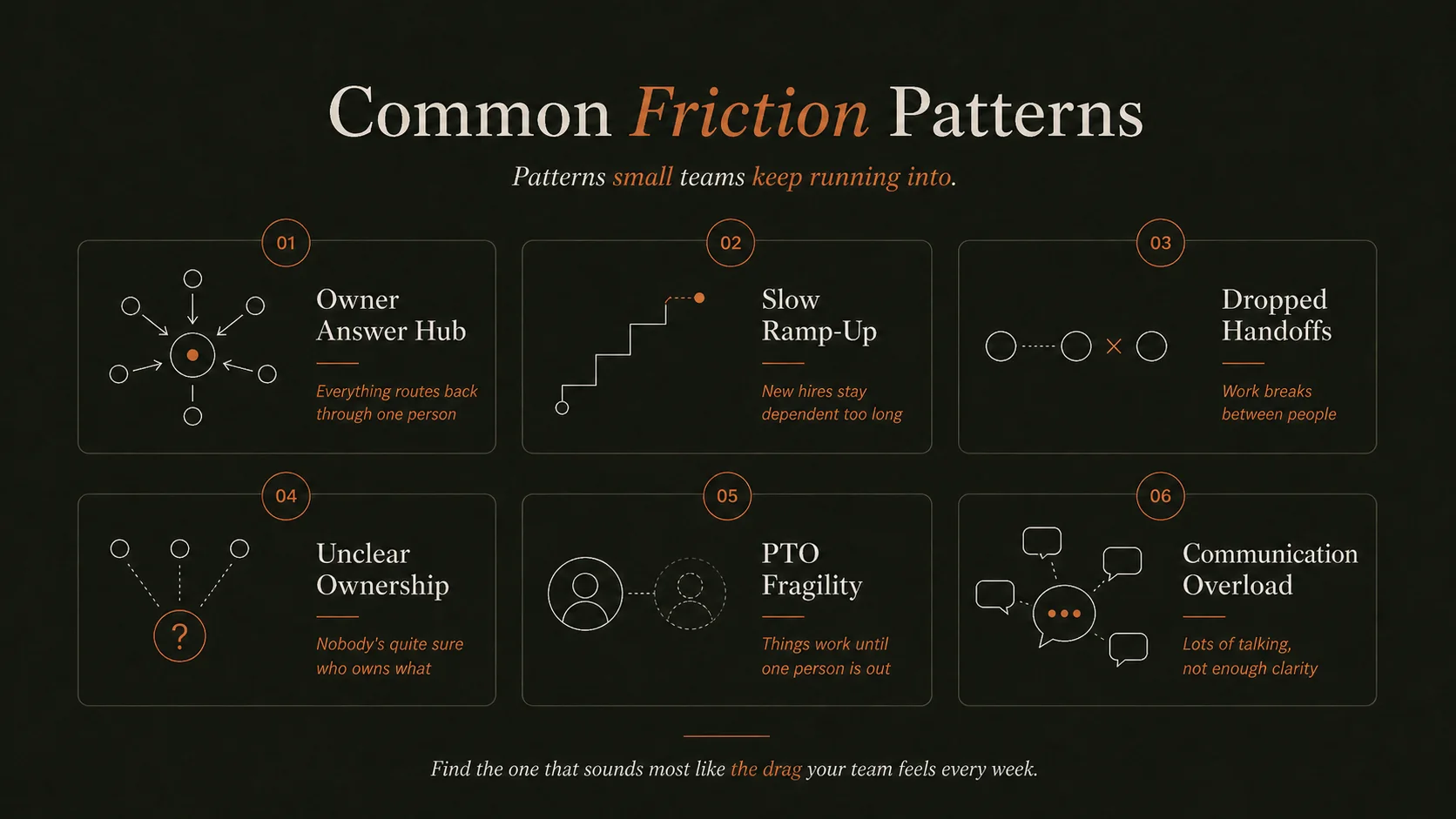
When everything routes through the owner
When everything keeps coming back to you
A growing team keeps routing questions, approvals, and decisions back to you — slowing work and making everything depend on you being available.
When new hires take forever to ramp up
When new hires take forever to get up to speed
Hiring is happening, but onboarding is inconsistent, knowledge transfer is verbal, and people take too long to become confident and independent.
When work breaks between people
When work breaks between people
Tasks move between people and teams without the context they need — missed details, duplicated effort, inconsistent delivery.
When ownership feels fuzzy
When nobody's quite sure who owns what
A realistic scenario showing how overlapping responsibilities create duplicated work, hesitation, and avoidable delays.
When everything's in one person's head
When everything works — until someone takes PTO
A realistic scenario showing how hidden knowledge creates fragility when one person is unavailable.
When the same conversations keep repeating
When the team talks constantly but still feels out of sync
A realistic scenario showing how constant communication can still leave teams misaligned without clearer channels and decision paths.
Not sure which one fits?
Start with the part that feels heaviest most days.
If more than one of these sounds familiar, that usually means there's one deeper thing underneath that's affecting multiple areas at once.
- Things routing back to you usually overlaps with fuzzy ownership.
- Slow ramp-up usually overlaps with weak documentation and handoffs.
- Constant back-and-forth usually hides unclear decision paths.
Need to choose?
A Clarity Map names what to fix first.
If you want to figure out which pattern matters most right now, start with a focused conversation instead of guessing.
Start here
Operations Systems for Small Teams
If you want one place that connects the core ideas on this site — who owns what, how work moves, how new people ramp up, and what to do when everything keeps coming back to you — start with the guide below.
Frequently asked questions
Operational Breakdowns FAQ
Are these real client cases?
No. These are realistic scenarios based on common friction patterns in owner-led teams. They are written so readers can recognize what may be happening in their own business without presenting hypothetical work as a formal case study.
How is an Operational Breakdown different from a blog post?
An Operational Breakdown is scenario-based. It shows what a specific pattern looks like in practice, what may be causing it, and how Fokaos would approach the fix. Operations Insights articles are broader and more educational.
Where should I start if one of these sounds familiar?
Start with the scenario that feels most like your team’s current friction point. If you are not sure which problem matters most, a Clarity Map identifies the bottleneck worth solving first.