
Start here
Five things that quietly hold a small team back.
You usually don't need more tools. You need clarity around who owns what, how work moves, how new people get up to speed, and how the team stays aligned without everything coming back to you.
Fokaos is an operations consulting practice based in Muskegon, Michigan and uses this same approach with owner-led teams across West Michigan and remote-first teams beyond it.
Use this as the big-picture guide. Each section links to the exact thing your team is feeling.
First, what this means
What "operations systems" actually means.
For a small team, "operations systems" just means the repeatable ways of working that let work move without you (or anyone else) having to interpret it every time. They don't have to be complicated. They just need to be clear enough that people can act with confidence.
Role clarity
Clear ownership, decision rights, and handoff expectations so work doesn't stall or boomerang back upward.
Onboarding
A consistent path for new hires to find their footing faster instead of learning everything through scattered conversations.
Workflow design
Simple, visible steps for recurring work so the team isn't relying on memory, guesswork, or individual heroics.
Communication rhythm
Lightweight meeting and update patterns that reduce confusion without creating more noise.
Common symptoms
Signs the way you've been running things isn't holding up.
- You keep becoming the answer hub for routine questions.
- New hires take too long to become steady and independent.
- Work gets dropped between people, tools, or departments.
- Meetings happen often, but decisions and next steps still feel fuzzy.
- Everything mostly works until someone's out sick or on PTO.
What that usually means
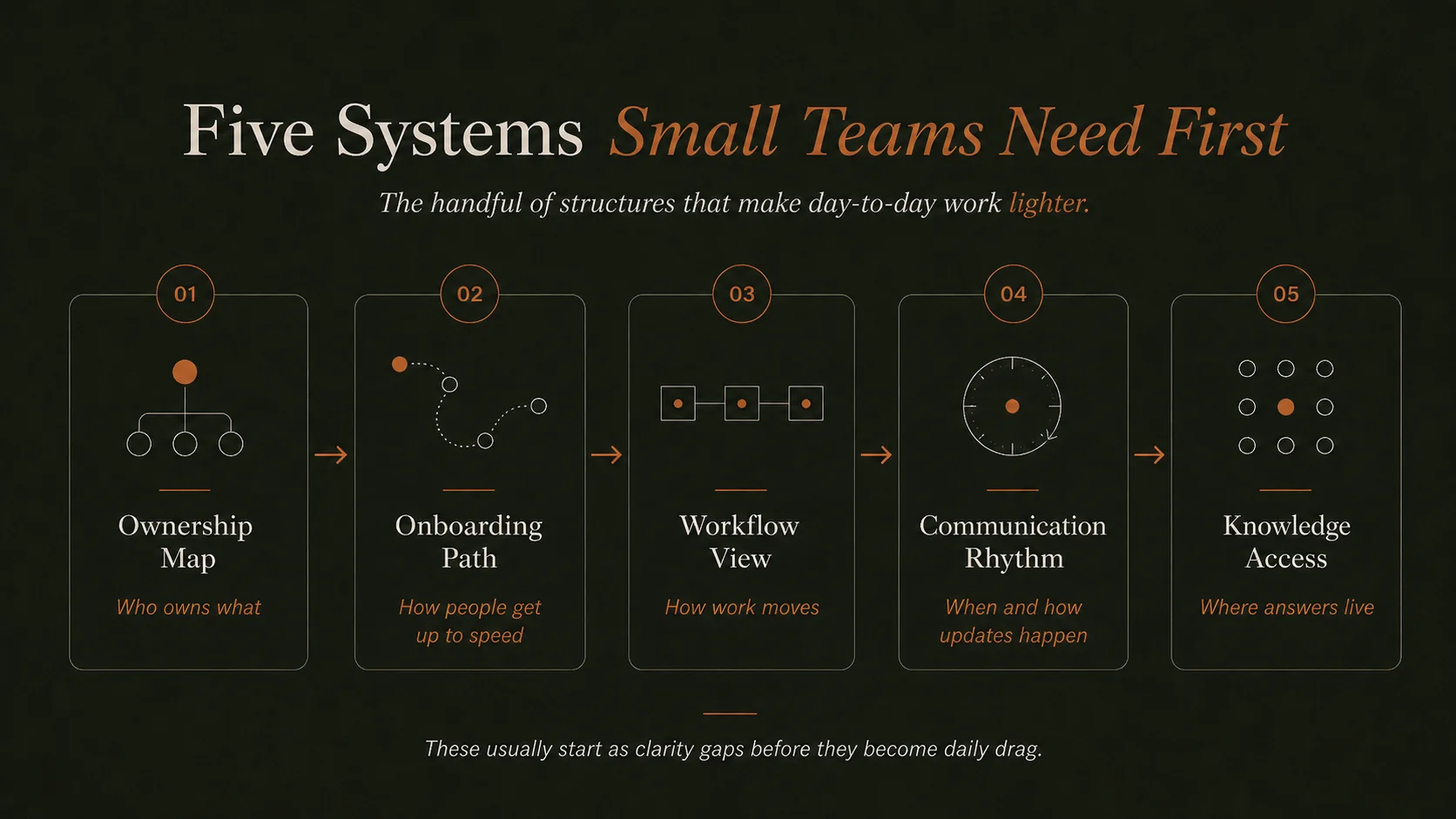
These usually begin as clarity gaps before they become daily drag.
When ownership is blurry, handoffs are weak, and the team has no steady weekly rhythm, even capable people end up rechecking work, escalating routine questions, or waiting for direction.
- Unclear ownership People are trying to move the work forward, but nobody is sure who really owns the decision once a job, project, or client issue is in motion.
- Fragile handoffs Work moves, but not with the context the next person actually needs — whether that is the crew, the coordinator, the account lead, or the person closing the loop.
- Too much routes through one person The system works only when one specific person is actively holding it together and filling the gaps in real time.
Where to focus first
The five things to build first.
You do not need to fix everything at once. Most teams get the biggest relief by strengthening a small set of things that remove weekly friction and stop the estimate, job, project, or client flow from depending on you.
Ownership map
Define what each role owns, where decisions live, and where work goes next.
Onboarding path
Give new hires one source of truth, core expectations, and a predictable ramp-up sequence.
Handoff system
Make sure work leaves one stage with the context the next person needs to keep moving.
Weekly operating rhythm
Create a light cadence for updates, blockers, and decisions so urgency isn't driving everything.
Documentation people can actually use
Keep a small set of useful documents people can find and trust, rather than a giant library nobody uses.
Start with the biggest drag
You don't have to overhaul the whole business to feel relief.
The most effective next step is usually to tighten the one thing the team feels every week, then build from there.
Use this page as your hub
Move from "something feels off" to the exact thing that's slowing you down.
This guide connects the rest of the site, so you can move from general operational drag to the specific breakdown your team is feeling right now.
Articles
Plain-language context for what is behind the friction — ownership, growth-stage drag, and why work keeps coming back to you.
Breakdowns
Real situations small teams hit when work outgrows the original way it was set up.
Want to apply this to your team?
Use this guide with your team
Fokaos works with owner-led teams that are capable, growing, and tired of relying on memory, constant check-ins, or one person carrying too much of the work.
Operations systems FAQ
- What are operations systems for a small team?
- Operations systems for a small team are the repeatable ways of working that let work move without the owner or any one person having to interpret or direct it every time. They cover role clarity, workflow design, onboarding, and communication rhythms.
- How do I know if my small business needs operations systems?
- Signs include: the same questions keep coming back to you, new hires take too long to become independent, work gets dropped between people, decisions get made twice, and everything slows when one person is out.
- Where should a small team start with operations systems?
- Start with the one friction point you feel every week. Role clarity, workflow design, onboarding, and communication rhythm are the four areas that matter most. Addressing the one that creates the most daily drag usually makes the others easier.
- What is role clarity in a small business?
- Role clarity means every person on your team knows what they fully own, what decisions they can make without approval, what good performance looks like, and where their work goes when they finish their part. When this is unclear, work routes back to the owner.